
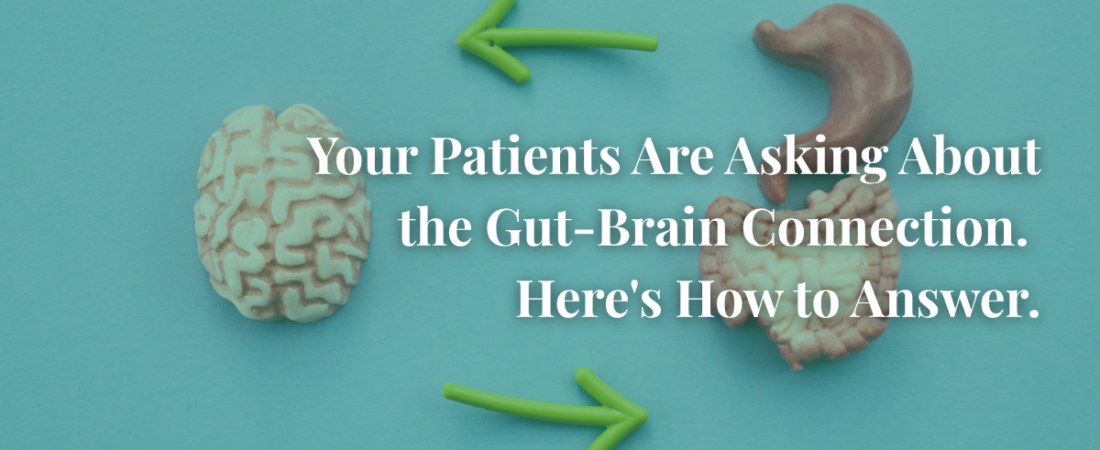
The Conversation Is Already Happening
Your patients have already read something about the gut-brain connection. Whether it’s accurate depends on where they read it.
The challenge for practitioners is this: the science is real, but the claims around it can be wildly overblown. And the compliance line between educational wellness conversation and diagnostic or treatment claim is one worth knowing.
What the Research Actually Shows
Here’s the version that’s supported by peer-reviewed evidence:
• 95% of the body’s serotonin is produced in the gut not the brain
• The gut and brain communicate continuously through the vagus nerve and via metabolites produced by gut bacteria
• Specific bacterial species are consistently associated with neurotransmitter production and regulation of the stress response
• Low levels of certain species (particularly F. prausnitzii and B. adolescentis) are correlated with depression and anxiety in population studies
This is not a fringe area of research. It’s a growing body of evidence that connects what happens in the gut to how a patient feels cognitively and emotionally.
The 3 Gutsy Species Most Linked to Mood
- Bifidobacterium adolescentis — supports GABA and serotonin synthesis; low levels correlated with mood disorders
- Faecalibacterium prausnitzii — anti-inflammatory; its absence is linked to depression and anxiety symptoms in clinical studies
- Roseburia intestinalis — butyrate production supports immune regulation that indirectly affects the gut-brain axis
How to Talk About This Without Overclaiming
This is where the practical value lives. Here’s what works:
- There’s research connecting gut bacterial balance to mood and cognitive function this gives us a picture of what’s happening.
- Think of this as additional context. It doesn’t replace what we know, but it can add a direction.
- Your gut bacteria produce neurotransmitters. Understanding your levels is a starting point, not a diagnosis.
What to avoid:
Any language that implies diagnosis, treatment, or a guaranteed outcome
This will tell us if your gut is causing your depression.
Any language that implies diagnosis, treatment, or a guaranteed outcome
The Bottom Line
Gut-brain health is a legitimate, growing area of clinical relevance. Practitioners who can navigate this conversation accurately staying on the right side of the compliance line while giving patients something meaningful are already ahead.Gutsy gives you a measurable starting point for that conversation. Not a diagnosis. A direction.